Learn how Surfee ends inefficiencies in industrial design 3D collaboration with cloud-based tools, simplifying file sharing and real-time feedback for all team members.


Ending Inefficiencies in Industrial Design 3D Collaboration
3D data plays a crucial role in product design projects. However, problems frequently arise here. While 3D designers work with professional software like Rhino, SolidWorks, and Blender, their collaborators from non-3D disciplines—clients, marketers, and manufacturers—are often unfamiliar with these tools or don't have them installed at all. Consequently, 3D designers bear the additional burden of converting their work into 2D images or PDFs, while non-3D professionals end up working without properly understanding the 3D data or referencing outdated versions.
This problem becomes even more severe when collaborating with external partners like overseas manufacturers. Large file transfers are constantly delayed, feedback gets scattered across messengers and emails, and the question "Is this the latest version?" never stops coming up. Document collaboration has already been simplified thanks to Figma and Google Docs—so why is 3D collaboration still so inefficient?
Why Is 3D Collaboration Always So Cumbersome?

Technical Barriers of 3D Data: 3D files often reach dozens or hundreds of megabytes, making email attachments difficult and requiring dedicated viewer programs. Moreover, when collaboration partners use different software, compatibility issues frequently prevent files from opening. Non-3D professionals lack tools to even view 3D models, forcing them to rely on 2D images or screenshots, which leads to incomplete communication with missing angles or details.
Inefficient Feedback Loops: For 3D designers to receive feedback, they must go through rendering processes to share 2D images—a process that often takes 2-3 hours each time. Conversely, feedback from non-3D professionals like "please change the color of this part" gets scattered across messengers and emails, making it difficult to track records. In global collaborations, time zone differences can extend feedback cycles to 2-3 days, directly leading to increased rework costs.
Surfee's Practical Approach: Cloud-Based 3D Collaboration
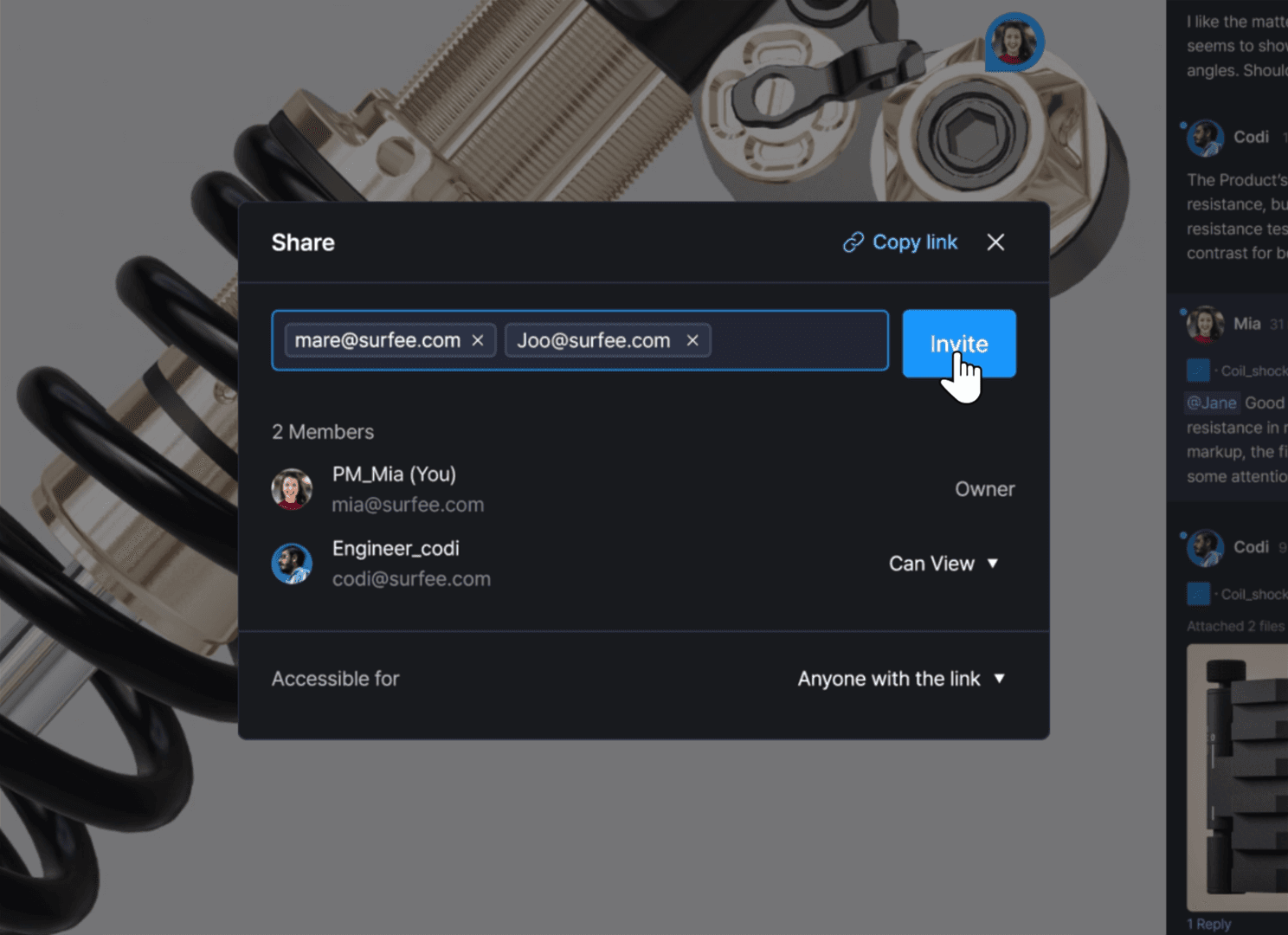
To solve these chronic problems, Surfee has emerged as a practical 3D product collaboration tool for 3D data. The core of this approach is 'cloud-based link sharing.'
Link Sharing Instead of File Transfers: Instead of exchanging heavy files via email or messenger, teams share 3D models with a single web link. Non-3D professionals like clients and marketers can view, rotate, zoom in, and zoom out of 3D models freely using just a web browser, without installing additional programs.
Real-Time Feedback and Transparent Version Management: Collaborators can add annotations directly to specific parts of 3D models on the web. All feedback and comments are recorded in one space, and version history is automatically managed whenever new versions are uploaded, eliminating concerns about "which version is the latest."
Easy Participation for Non-Experts: The 3D product collaboration tool provides a non-expert-friendly environment. Clients and marketers can directly examine models and provide specific feedback like "I'll give you my opinion after checking this angle" without 3D expertise. This reduces feedback cycles from days to hours and dramatically cuts unnecessary rendering time.
Making 3D Collaboration as Simple as 2D
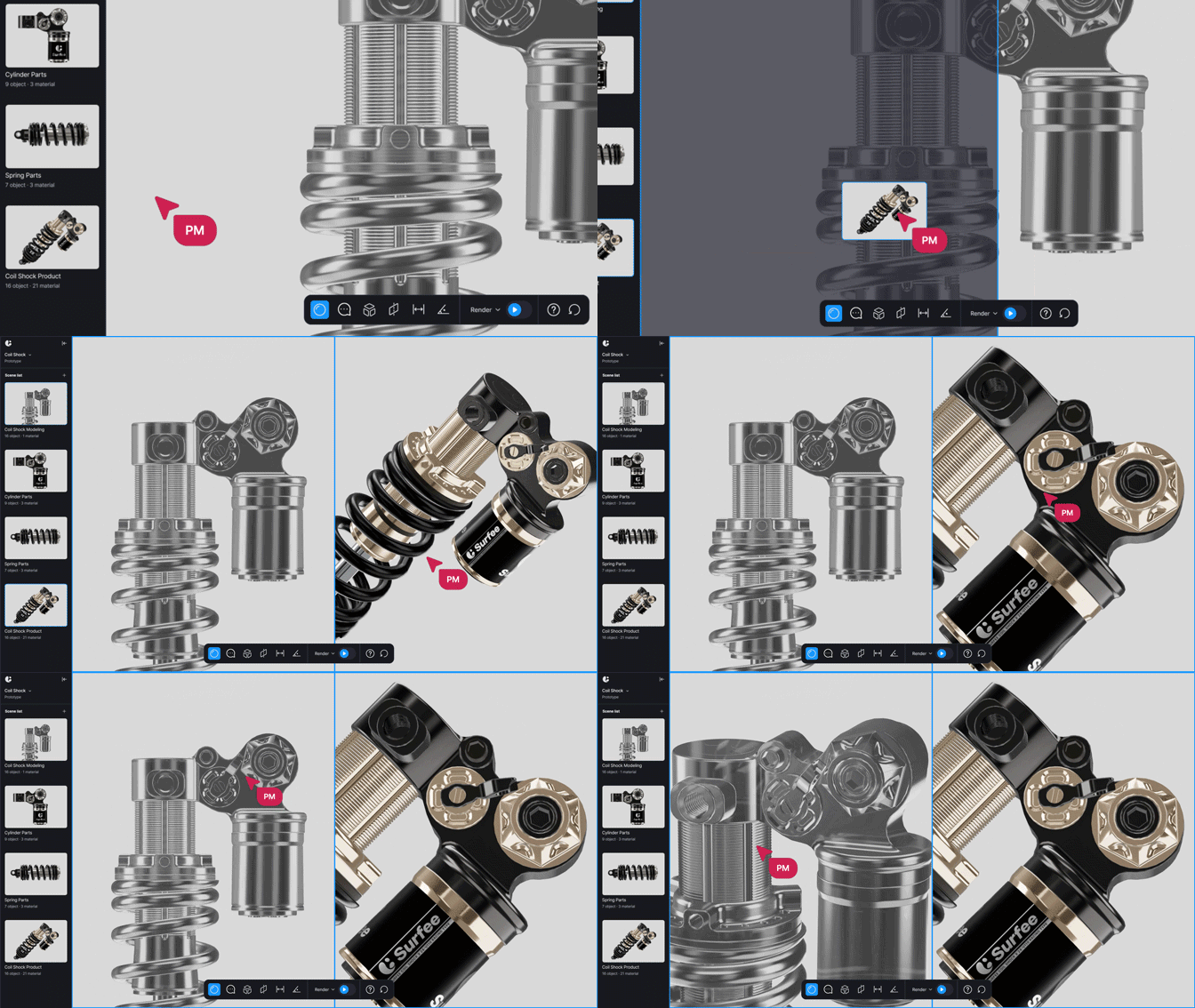
Just as Figma completely transformed 2D collaboration methods, 3D collaboration is also transitioning toward cloud-based tools. The key to successful 3D collaboration lies in creating an environment that goes beyond simple file sharing to enable real-time communication, transparent feedback records, and integrated version management.
Surfee provides a practical solution that reduces the workload burden on 3D designers while helping non-3D professionals participate more actively in projects. Such an efficient collaboration environment can accelerate project timelines and ultimately create opportunities for better outcomes. Isn't this kind of change worth exploring?