Learn how fast 3D feedback with tools like Surfee accelerates product development, overcoming rendering delays and enhancing collaboration efficiency.

Is Your 3D Design Collaboration Still Stuck in the Past?
If you work in a design agency or industrial design team, you’re likely all too familiar with the repetitive process of rendering 3D models and capturing images for feedback. Just as Figma revolutionized 2D design communication, 3D collaboration is evolving with web-based solutions, yet many teams remain tethered to outdated, inefficient workflows. For decades, these methods have been taken for granted, often without recognizing their inefficiencies. But it’s worth asking: “Is the way we’ve always done it truly the most effective approach?”
Endless 3D Rendering: A Cycle of Wasted Time

In industrial design, 3D Rendering is essential for visualizing product ideas. However, this process often feels like an endless loop. From initial concept stages to final client reviews, even minor design tweaks—like a color change or texture adjustment—require fresh renders, each taking hours. This repetitive rendering has become an accepted norm, but it’s a major bottleneck, slowing down the entire project timeline and draining productivity.
The Limits of 2D Images in Capturing 3D Context
Many teams rely on capturing 2D images of 3D models, adding annotations or creating documents for feedback. While seemingly straightforward, this approach risks losing critical context. For example, missing specific angles or details in captures can lead to feedback errors, and when multiple stakeholders—clients, engineers, or marketers—provide input simultaneously, confusion often escalates. Feedback conflicts among diverse stakeholders further delay progress. The core issue lies in the inherent limitation of 2D images to fully convey the depth and context of a 3D model.
Feedback Bottlenecks and Rising Costs

Physical distance significantly reduces communication efficiency. In global collaborations or with overseas factories, the process of transferring files and receiving feedback stretches out, creating bottlenecks. These delays don’t just affect schedules—they drive up costs. Late feedback can lead to additional labor expenses or unexpected revisions, increasing rework costs. In the industrial design industry, these feedback bottlenecks directly impact project profitability. To address this, web-based solutions that streamline 3D Rendering and collaboration are emerging.
The Rise of New Tools and Their Value
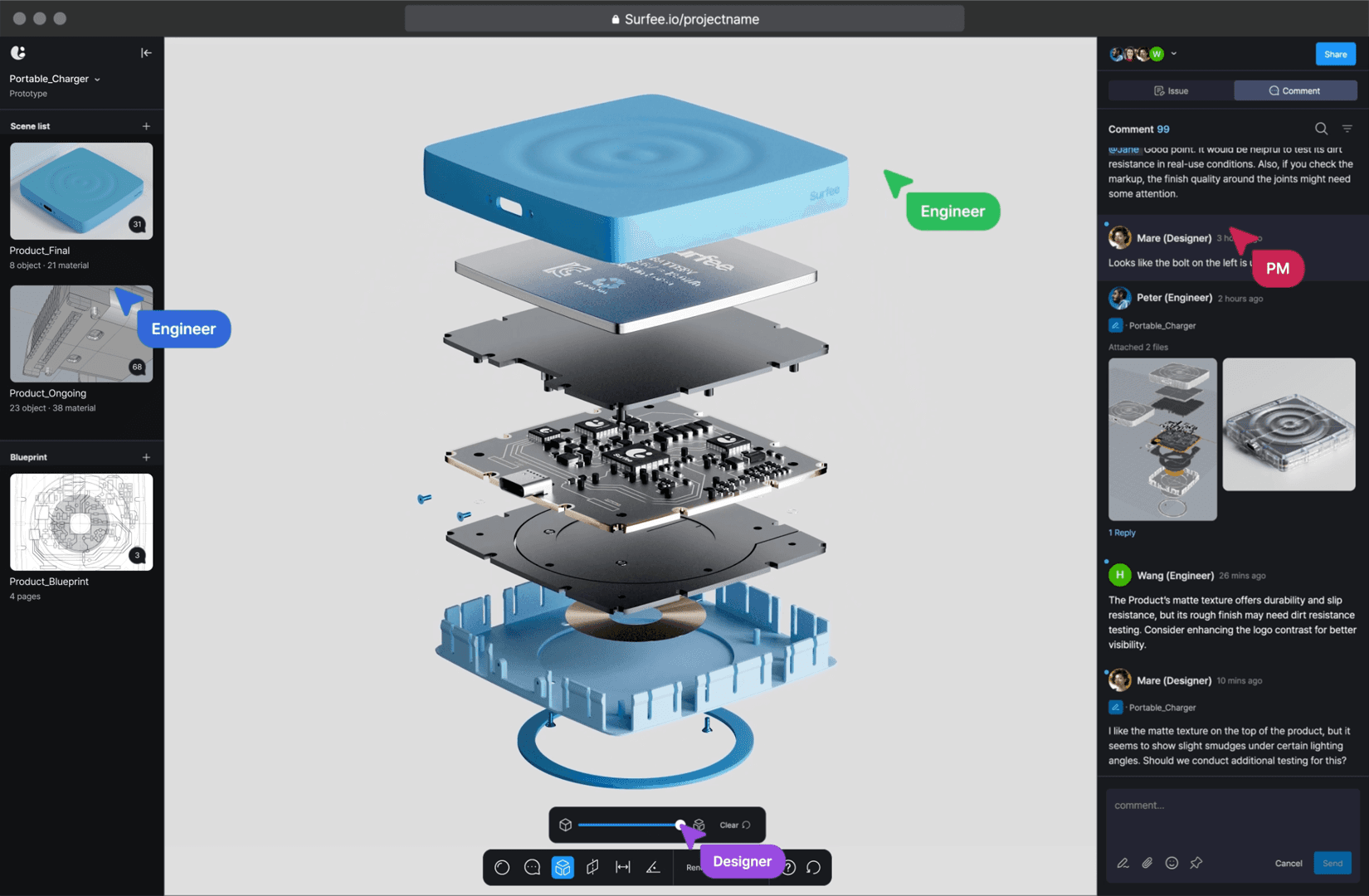
In industrial design, 3D collaboration has long been plagued by inefficiencies: repetitive rendering, context loss from 2D images, and slow feedback bottlenecks. For instance, designers often spend hours rendering images to address client feedback, while non-3D professionals struggle to grasp a 3D model’s intent from flat visuals. To tackle these challenges, web-based 3D collaboration tools have emerged, and Surfee, a 3D product collaboration tool, offers a practical solution to these inefficiencies.
Surfee significantly reduces these pain points by enabling direct 3D model sharing and real-time feedback on the web. For example, when a designer receives a color change request, instead of re-rendering 2D images, Surfee allows clients to rotate and annotate the model directly in a browser, cutting hours-long rendering and sharing processes down to minutes. Furthermore, with feedback and version history consolidated in one platform, confusion over questions like “Does this feedback apply to the latest version?” is eliminated. Surfee eases the workload for designers and empowers non-3D professionals, like clients and manufacturers, to understand 3D models effortlessly. If you’ve experienced these challenges in your work, trying Surfee could be a game-changer.